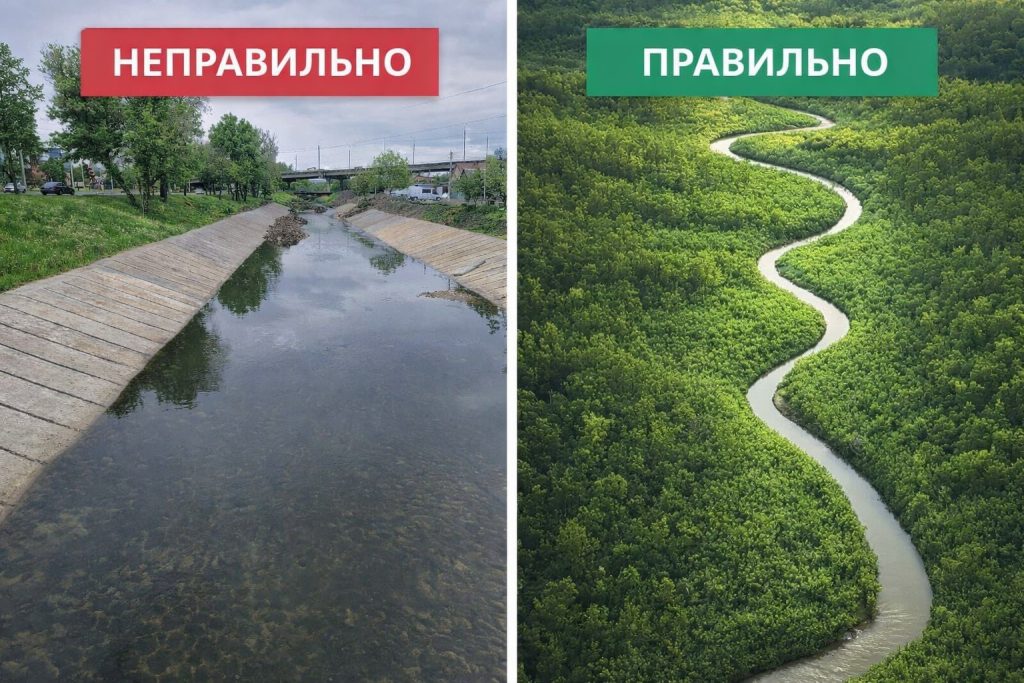
Hydrological studies by the US Geological Survey as early as the 20th century (Leopold & Wolman, 1960) demonstrated that when a river is confined by concrete banks and its channel is straightened, the flow velocity increases sharply. The river effectively turns into a pipe.
The same process is happening with the Bîc River in Chișinău.
During heavy rainfall, water can no longer spread across the floodplain or be absorbed by vegetation and soils. Instead, it rushes downstream at dangerous speeds.
More recent studies (Brody et al., 2019, Journal of Environmental Management) confirm that cities with heavily channelized rivers suffer greater flood damage—especially under extreme rainfall events, which are becoming more frequent due to climate change.
Concrete does not absorb water, does not filter it, and does not cool the city. It only accelerates the flow and transfers the problem further downstream.
The core problem is not the rivers themselves, but their straightening.
During the Soviet period, many river sections were straightened to expand agricultural land and to build highways, railways, and other infrastructure.
Today, “cleaning” 1 km of a river in Moldova costs between 800,000 and 1.5 million lei. And these works must be repeated again and again—the costs never end.
The only sustainable solution is restoring river meanders, not further deepening and straightening channels.
Rivers meander because this is nature’s way of dissipating water energy and balancing bank erosion with sediment deposition on floodplains.
Meanders:
slow down the flow,
reduce the risk of catastrophic floods,
support floodplain ecosystems.
Straightening rivers, by contrast, accelerates flow, dries out floodplains, destroys ecosystems, and shifts flood risk downstream.
Rivers with natural banks, vegetation, and floodplains behave very differently.
The Intergovernmental Science-Policy Platform on Biodiversity and Ecosystem Services (IPBES, UN, 2019) shows that restored riverbanks, wetlands, and floodplains can:
reduce flood peaks by 20–40%,
slow water flow,
recharge groundwater,
filter pollutants before they enter the river.
This is exactly what the Bîc River and many small rivers of Moldova—including the Răut River and its tributaries—are lacking today.
According to the World Bank (2019), every 1 euro invested in nature-based and sustainable infrastructure saves up to 4 euros in disaster recovery costs.
The OECD (2020) emphasizes that:
concrete solutions require constant repairs,
their costs increase with every extreme flood,
they adapt poorly to changing climate conditions.
For Chișinău, this means millions of lei spent not on urban development, but on dealing with the consequences of outdated approaches.
Research by Palmer et al. (2010, Science) shows that river restoration leads to:
the return of fish,
increased bird populations,
recovery of pollinators,
improved water quality within 3–5 years.
For the Răut River and its tributaries, this is a real chance to restore ecosystem functions lost due to channel straightening, removal of riparian vegetation, and agricultural pressure.
Green zones along rivers are not a luxury—they are a climate necessity.
According to Urban Climate research (Gunawardena et al., 2017), green river corridors:
reduce air temperatures by 1–3°C,
mitigate the urban heat island effect.
For Chișinău, which increasingly suffers from summer heat, restoring the Bîc River is a matter of public health and comfort.
Around the world, cities are moving away from concrete:
Germany and the Netherlands implement the “Room for the River” policy,
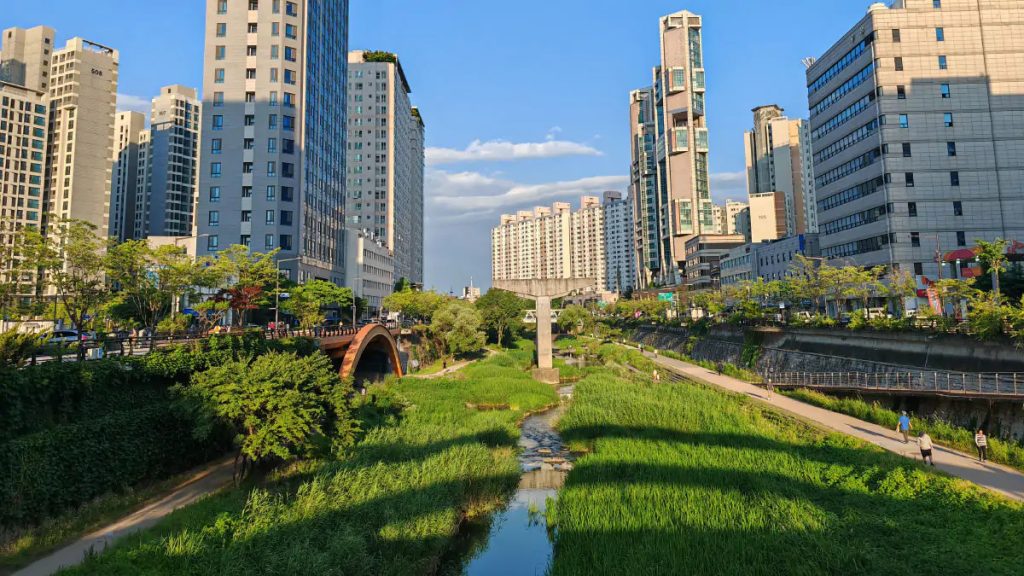
Seoul removed concrete and restored the Cheonggyecheon River,
France is investing heavily in the renaturalization of small rivers.