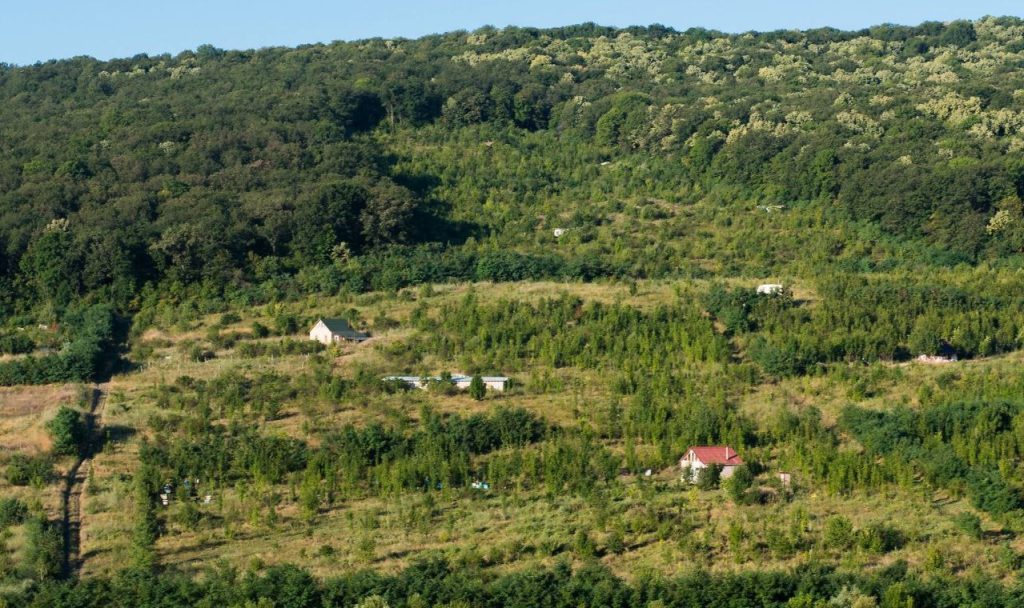
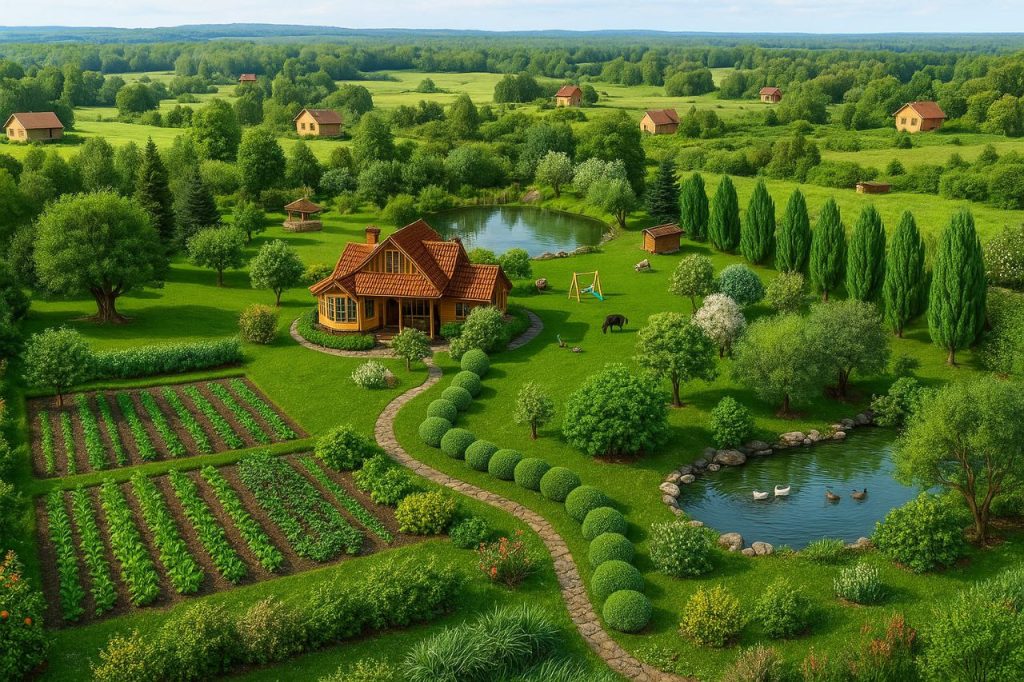
One such example is the ecological settlement in Codreanca commune, Strășeni district, described in detail in the year project of Vladislav Sanduleac, an ecology student at the Technical University of Moldova (“The characteristics of environmental components and protection measures for certain resources in Codreanca commune, Strășeni district”, 2025).
According to the author’s research, the ecological settlement project in Codreanca was initiated in 2003. Today, on an area of 40 hectares, about 20 families manage homesteads based on the principles of permaculture and biodiversity restoration. Each family owns between 1 and 2.7 hectares of land, creating so-called homesteads that combine traditional agricultural practices with modern ecological approaches.
The ecology student explains the scientific origin of the term “ecological settlement”: “The term Ecological Settlement was introduced into scientific discourse by Professor George Ramsey of the Georgia Institute of Technology in his 1978 presentation ‘Application of Passive Energy for the Artificial Environment’ at the First World Energy Conference, organized by the Association of Energy Engineers. Ramsey argued that the problems related to excessive energy use are not about technology, but about the lifestyle of the population.”
In his work, Vladislav Sanduleac also presents some historical data about the development of ecological settlements in Moldova and worldwide: “In 1991, the Global Ecovillage Network (GEN) was created. In 2001, GEN obtained special consultative status with the UN Economic and Social Council (UN-ECOSOC) and became a partner of the United Nations Institute for Training and Research.”
“Today, various countries have enacted laws that encourage the development of ecological settlements, and over 10,000 such settlements have been registered under cooperative, biodiversity protection, non-profit, and urban planning legislation in Europe, America, and Australia. In addition, in Russia, in 2013, the Belgorod region adopted a regional law on family homesteads that regulates the free allocation of 1-hectare land plots for a period of 49 years for the creation of sustainable family farms,” explains the author.
Vladislav Sanduliac also provides some data: “In the territory of the ecological settlement in Codreanca commune, over the course of 20 years, plots with permaculture forest-gardens have formed, where plantations cover between 15% and 60% of the land, matching the best afforestation rates in European countries. No pesticides or chemical fertilizers are used, beekeeping is actively developing, and organic waste is composted and used as fertilizer.”
Special attention in the project is given to the conservation and increase of local species of flora and fauna. The territory of the settlement has become a refuge for pheasants, quails, hares, hedgehogs, as well as rare plant species listed in Moldova’s Red Book.
An equally important aspect, according to Vladislav Sanduleac, is the use of solar energy: solar power stations have been installed on the territory, ensuring the settlement’s energy autonomy.
The analytical part of the study highlights that the ecological settlement in Codreanca fully complies with international environmental conventions, including the Convention on Biological Diversity and the UN Framework Convention on Climate Change. Moreover, the project is part of the Global Ecovillage Network, which confirms its international recognition.
In his work, Vladislav Sanduleac formulates concrete recommendations for the Codreanca village administration. The experience of the ecological settlement in Codreanca commune can serve as a foundation for similar initiatives across Moldova, contributing to nature restoration, the development of the green economy, and the formation of new environmental awareness in the country. For Codreanca, it can also be the basis for the development of ecological tourism.
This project demonstrates that sustainable development is possible even in small rural communities if the efforts of residents, local authorities, and the ecological community are united.
The full version of the study can be consulted at the link: