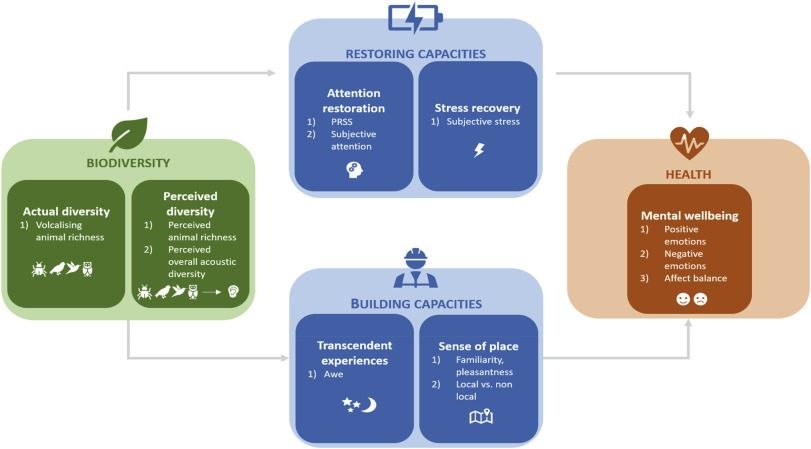
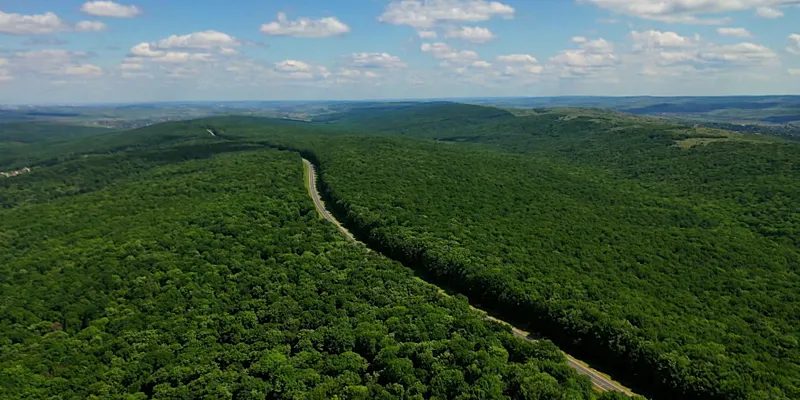
The study found that soundscapes of local forests have a stronger positive effect on the human psyche than the sounds of “exotic” natural environments. This means that for people living in Moldova, native forests—such as the Codrii—may be the most restorative.
In other words, it’s not just the number of sounds that matters, but their naturalness, familiarity, and connection to living nature.
Humans are evolutionarily connected to their natural environment. The sounds of birds, insects, and rustling leaves create a sense of safety and belonging. That is why forests rich in biodiversity can:
The Codrii are one of the few regions in Moldova where relatively high species diversity is still preserved. This makes them not only ecologically valuable but also psychologically important for people.
Acacia plantations are good for firewood, but do they improve mental health?
It is important to address a separate issue relevant to the Republic of Moldova: the large-scale planting of acacia trees.
Although acacia is often used for rapid greening efforts, it is important to understand that monocultures are not real forests.
Such plantations:
have low biodiversity
create poor soundscapes
do not form a complete ecosystem
may cause a feeling of monotony in people
The study indirectly confirms this: when the sound environment is not perceived as “alive” and rich, it does not provide psychological comfort.
If Moldova wants not just to “plant trees,” but truly restore nature and improve people’s quality of life, it is necessary to:
Biodiversity is not a luxury—it is the foundation of both environmental and human health.
The experiment involved 195 students from Germany. They were asked to listen to recordings of forest soundscapes:
Researchers analyzed:
Researchers emphasize that it is not enough to increase diversity—it must be ecologically meaningful and perceptible to humans.
In conclusion, the Codrii are not just a green area on the map. They are a place where nature can truly heal—through sound, atmosphere, and biodiversity.
And perhaps the best отдых for Moldovans is not a flight to another country, but a return to their own nature.
🔗 Study link:
https://www.sciencedirect.com/science/article/pii/S0272494426001088