
Last spring, the government of Moldova approved a new Forest Code, and in the summer, everyone was caught off guard by an extreme heatwave. This summer, record heat and drought are again being forecast. What in this new code protects us from heat and drought? Nothing…
It turns out that the code was not written to counter the looming climate change, but to comply with new European standards.
European standards are not bad, but they are too small for us. In some European countries, forests cover 75% of the territory, while in our country — only 11%, the worst indicator in Europe. That’s why the advice of Europeans should be boldly multiplied several times, and we must create braver laws that will truly restore our forests and help fight climate change — not just adopt laws to check a box for the European Commission.
The boldest decision for Moldova, as many experts have repeatedly stated, is a complete ban on logging.
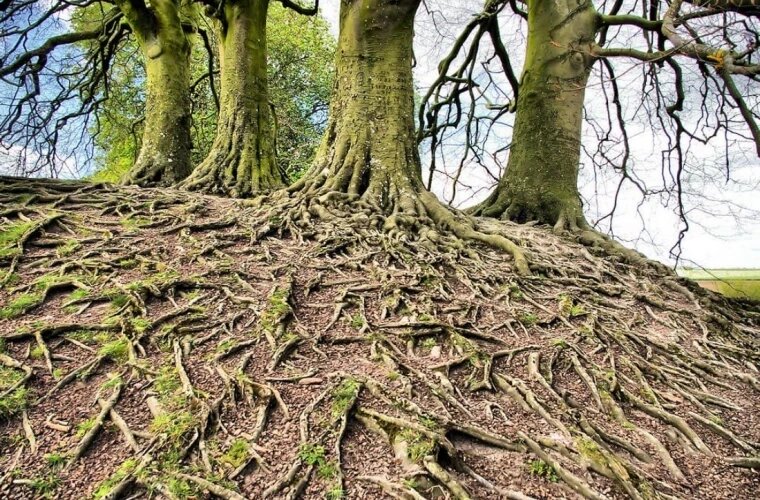
Biologist Valeriu Arvat explained to us the crucial role of the deep roots of old trees in preserving moisture in the soil and combating drought.
There are hardly any of these old trees left — the ones capable of saving the land from drought. Foresters are cutting trees too quickly, and the so-called “mature trees” are getting younger and younger.
So, what is the secret of old trees? Trees are like massive pumps that draw water from the lower layers of the soil to the upper ones. They also act as reservoirs that can retain moisture in the upper soil layers from rainfall. Young trees, unlike old ones, simply consume water from the soil, but only old trees are capable of pulling it upward and holding it near the surface.
The fact is that trees, like all living things on the planet, are made of carbon, and according to biologist Valeriu Arvat, every molecule of carbon can retain up to four molecules of water. By studying the relationship between soil composition and plant health using the method of American doctor Carey Reams, this Moldovan expert achieved high-quality and nutrient-rich fruits in agriculture.
Biologists know that for a plant to perform photosynthesis, it needs three things: water, carbon dioxide (CO₂), and energy (sunlight). As a result, trees produce sugars (glucose) and release oxygen (O₂) for humans.
For example, to build one molecule of glucose, 12 atoms of hydrogen are needed. Hydrogen enters the plant through water via the roots. Therefore, for a plant to grow, it must absorb and retain water.
According to Valeriu Arvat, small plants are unable to draw water from the deep layers of the soil, and if the upper layers dry out, the plant dries out as well. Only old, century-old trees can lift water to the upper layers of the soil, thus providing life-giving moisture to younger plants and even replenishing human springs and wells. In addition, old trees have denser crowns that better shade the soil and prevent excessive evaporation of moisture.
But because almost no old trees remain in Moldova’s 11% forested area, we are at the very beginning of a serious climate collapse. And to prevent Moldova from turning into an African desert, we must impose a complete ban on logging for many years, so that century-old trees with deep root systems can return.
Below is an important informational note. Maybe members of the government will read it, write proper laws, and then Moldova’s small rivers will fill up again, the Dniester will deepen, and we will stop suffocating from excessive heat.
Mechanism of capillary water rise:
Some trees, especially those growing in arid or semi-arid regions, have roots that can reach significant depths, sometimes even reaching groundwater. These are called taproots or deep roots.
These roots can extract water from deep soil layers where the roots of other plants cannot reach. This is especially important during droughts when the upper soil layers dry out.
Trees with deep roots can release part of the absorbed water into the upper soil layers through their surface roots. This process is called hydraulic redistribution.
The water released by the tree into the upper soil becomes available to other plants with shallower roots. This is vital in ecosystems with high competition for water.
Hydraulic redistribution helps maintain the microclimate and biodiversity, ensuring access to water for understory and other plants that cannot reach deep water sources.
Studies show that in arid regions, up to 30% of the water absorbed by a tree’s deep roots can be redistributed to the upper soil layers, improving the ecosystem’s water balance. For example, oaks with deep roots support many other plant species, especially during summer when surface water disappears.
Vladislav Sanduleac,
eco-activist