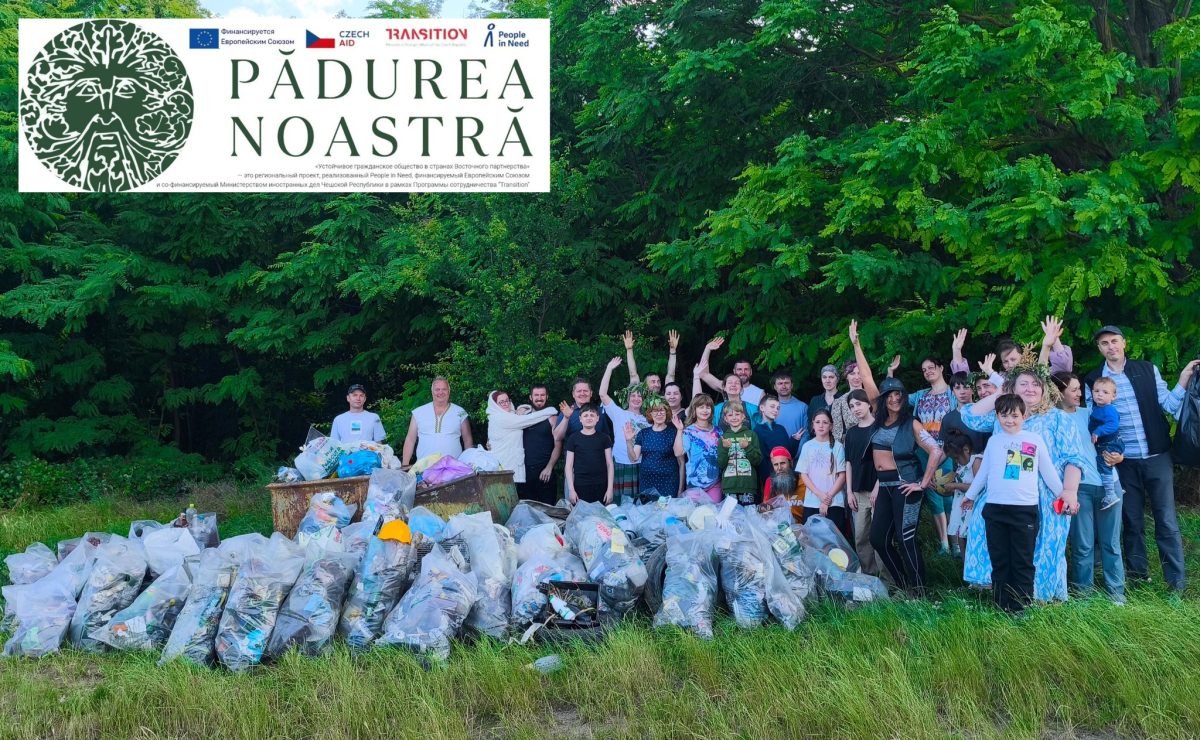
This location is known for accumulating large amounts of waste for two main reasons: the careless attitude of visitors and the lack of attention from the city administration. Although the municipality does not consider this area a proper recreation and tourism zone and does not invest in its maintenance, city residents continue to spend their leisure time there.
“It is clear that something needs to be done about this,” the organizers stated.
New volunteers from Moldova and Ukraine joined the action, giving the event a humanitarian dimension as well. Participants combined the cleanup with celebrating the Summer Solstice in the traditional Slavic-Moldovan style of Kupala-Sânziene, offering Ukrainian guests an atmosphere that reminded them of home and their traditions.
A total of 52 people took part in the cleanup, and as the organizers noted, it was “a truly warm and unifying event.”
The team extends special thanks to their sponsors, whose support made this celebration of cleanliness possible. The event was supported by the project “Sustainable Civil Society in the Eastern Partnership Countries,” implemented by People in Need, funded by the European Union, and co-financed by the Ministry of Foreign Affairs of the Czech Republic within the framework of the “Transition” cooperation program. In Moldova, the project is implemented by People in Need Moldova.


“I’ve been under the impression of my findings for a week now since finishing my coursework. I’m especially pleased with the knowledge I’m gaining at the university. It turns out that ecology is a very precise science that allows us to evaluate the state of the environment in numbers and coefficients, and accurately determine the degree of pollution and ways to solve problems,” said Vladislav.
According to the student, thanks to this knowledge he realized how much the profession of an ecologist is in demand in the modern world:
“For any village or business, it is possible to create an environmental project that can help attract funding to improve the living environment. It’s a real tool for change.”
Vladislav also highlighted the importance of training at UTM:
“I advise young people to pay attention to this field. The university has retained a strong teaching staff that continues the best traditions of the former Agrarian University,” he emphasized.
Village: Numbers That Shock
The main theme of Vladislav’s coursework was the study of the environmental situation of a Moldovan village. The results were surprising.
“You’d think that a village is about nature and ecology. But when I started calculating the indicators, the picture turned out to be completely different,” the student shared.
He found that a typical village with 1,000 households produces about 700 tons of manure per year.
“This could become valuable fertilizer if a composting system worked. But in reality, most of the manure ends up in the soil and pollutes well water. Part of it is taken to landfills, where it mixes with plastic and chemicals, poisons the soil, and often smolders or burns,” Vladislav explained.
The situation is worsened by the uncontrolled use of pesticides, which leads to mass deaths of bees.
“The village lacks biodiversity: there are mainly fruit trees, walnut trees, and gardens. Forest plants and animals simply have nowhere to live. Deep plowing and the absence of shelterbelts contribute to erosion — fertility is carried away by wind and rain,” he added.
Eco-Settlement: European Standards on Moldovan Soil
Comparing the situation to an eco-settlement, Vladislav saw a fundamentally different picture.
“An eco-settlement of 40 hectares, where about 20 families manage plots ranging from 1 to 2.7 hectares, became for me an example of harmony with nature,” he noted.
According to him:
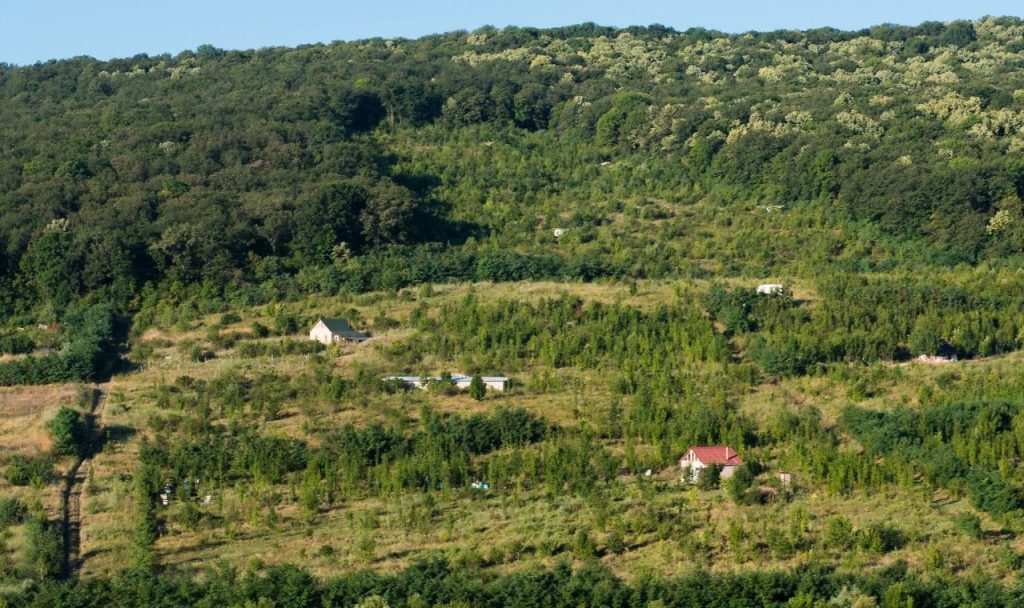
Two-thirds of each plot’s area is occupied by permaculture forest gardens, where biodiversity thrives, including species from the Red Book.
The soil is not plowed and is protected by vegetation from erosion. On some plots, terracing has been applied, and aquatic ecosystems have been created for birds and fish.
There are no landfills or large cattle in the settlement, so there is no soil pollution from waste.
No pesticides or chemicals are used — natural fertilizers and bio-organisms are applied.
Beekeeping is developed, which has a positive effect on plant pollination.
“This example embodies the highest European standards: in climate change adaptation, biodiversity enhancement, and the greening of human life. This experience needs to be studied and spread throughout the country,” believes Vladislav Sanduleac.
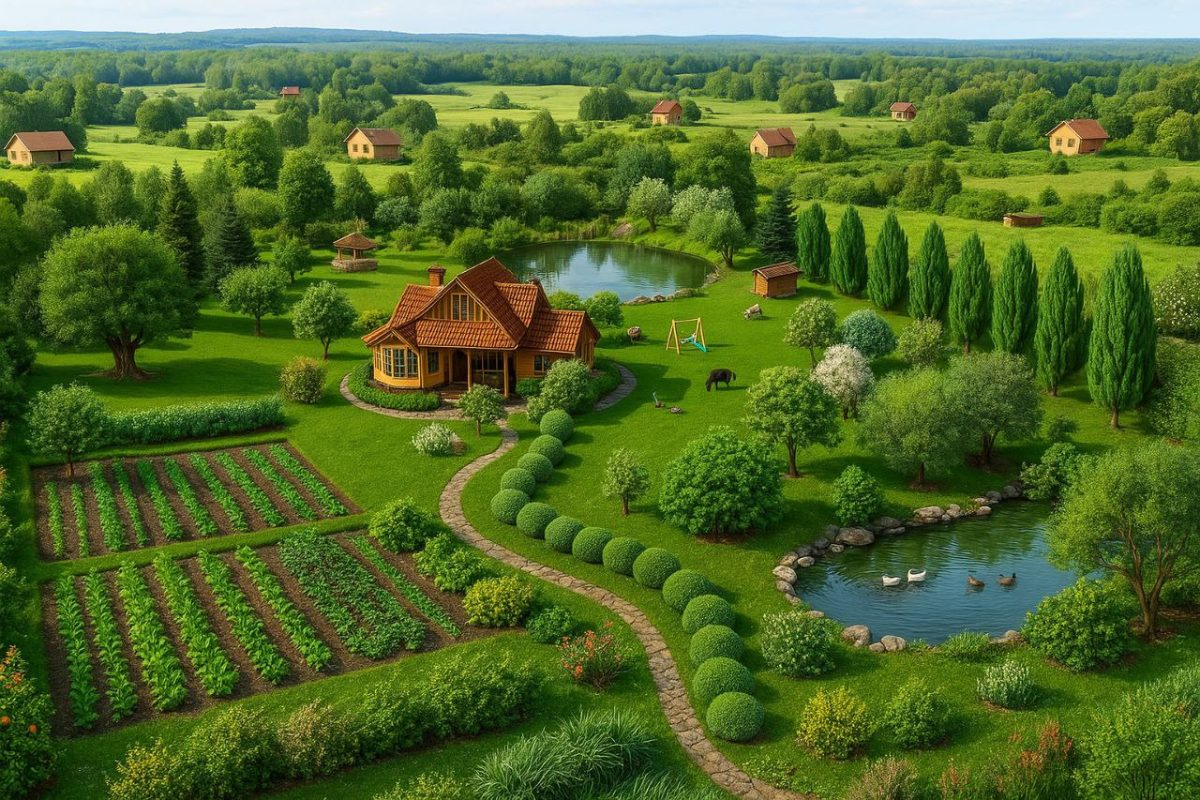
One such example is the ecological settlement in Codreanca commune, Strășeni district, described in detail in the year project of Vladislav Sanduleac, an ecology student at the Technical University of Moldova (“The characteristics of environmental components and protection measures for certain resources in Codreanca commune, Strășeni district”, 2025).
According to the author’s research, the ecological settlement project in Codreanca was initiated in 2003. Today, on an area of 40 hectares, about 20 families manage homesteads based on the principles of permaculture and biodiversity restoration. Each family owns between 1 and 2.7 hectares of land, creating so-called homesteads that combine traditional agricultural practices with modern ecological approaches.
The ecology student explains the scientific origin of the term “ecological settlement”: “The term Ecological Settlement was introduced into scientific discourse by Professor George Ramsey of the Georgia Institute of Technology in his 1978 presentation ‘Application of Passive Energy for the Artificial Environment’ at the First World Energy Conference, organized by the Association of Energy Engineers. Ramsey argued that the problems related to excessive energy use are not about technology, but about the lifestyle of the population.”
In his work, Vladislav Sanduleac also presents some historical data about the development of ecological settlements in Moldova and worldwide: “In 1991, the Global Ecovillage Network (GEN) was created. In 2001, GEN obtained special consultative status with the UN Economic and Social Council (UN-ECOSOC) and became a partner of the United Nations Institute for Training and Research.”
“Today, various countries have enacted laws that encourage the development of ecological settlements, and over 10,000 such settlements have been registered under cooperative, biodiversity protection, non-profit, and urban planning legislation in Europe, America, and Australia. In addition, in Russia, in 2013, the Belgorod region adopted a regional law on family homesteads that regulates the free allocation of 1-hectare land plots for a period of 49 years for the creation of sustainable family farms,” explains the author.
Vladislav Sanduliac also provides some data: “In the territory of the ecological settlement in Codreanca commune, over the course of 20 years, plots with permaculture forest-gardens have formed, where plantations cover between 15% and 60% of the land, matching the best afforestation rates in European countries. No pesticides or chemical fertilizers are used, beekeeping is actively developing, and organic waste is composted and used as fertilizer.”
Special attention in the project is given to the conservation and increase of local species of flora and fauna. The territory of the settlement has become a refuge for pheasants, quails, hares, hedgehogs, as well as rare plant species listed in Moldova’s Red Book.
An equally important aspect, according to Vladislav Sanduleac, is the use of solar energy: solar power stations have been installed on the territory, ensuring the settlement’s energy autonomy.
The analytical part of the study highlights that the ecological settlement in Codreanca fully complies with international environmental conventions, including the Convention on Biological Diversity and the UN Framework Convention on Climate Change. Moreover, the project is part of the Global Ecovillage Network, which confirms its international recognition.
In his work, Vladislav Sanduleac formulates concrete recommendations for the Codreanca village administration. The experience of the ecological settlement in Codreanca commune can serve as a foundation for similar initiatives across Moldova, contributing to nature restoration, the development of the green economy, and the formation of new environmental awareness in the country. For Codreanca, it can also be the basis for the development of ecological tourism.
This project demonstrates that sustainable development is possible even in small rural communities if the efforts of residents, local authorities, and the ecological community are united.
The full version of the study can be consulted at the link: